Work out what needs to change after 50, and what to do next.
Practical ideas, tools, coaching and mentoring for people over 50 rethinking work, money, time and what comes next.
Featured on BBC Radio following the response to my first video
Wayne holds the TQUK Level 3 Award in Coaching and Mentoring (RQF)

If You’re Unsure Where To Begin
This space isn’t linear.
You do not need to work through everything in order.
Start with the route that best matches what you need now: understanding the pressure, exploring the ideas, working through something privately, or getting ongoing support.
Structured Entry Points
For people over 50 who want to shape the next 10–15 years of work and life more deliberately.
Have one particular decision, idea or problem you'd like to talk through? Book a private 60-minute conversation to explore it together and work out what might come next.
Answer 15 questions to get an indication of the pressure you're reporting around work, control and financial constraints after 50.
Read the main ideas around money, outside noise and the gradual drift of time after 50.
Use a structured private process when one decision keeps circling and you want to work through it independently.
One way I approach clarity
This video shows one example of how I think things through — by questioning assumptions, slowing the pace, and removing pressure before trying to reach a decision.
It’s not a method to follow, and it’s not meant to be definitive. It’s simply a way of thinking that some people find useful when things feel noisy or unsettled.
Responses to this way of thinking
Learning to ask better questions instead of giving advice is something people charge thousands to teach — this explained it more clearly than I’ve heard it put before.
— YouTube comment on How I Learned to Ignore Other People’s Opinions
Beyond what you say, it’s how you say it — calm, reflective, and without hype. Every video feels like an opportunity to pause and think.
— YouTube comment on The Real Reason We Stay in Jobs That Make us Unhappy
A short BBC Radio conversation
After my first video about leaving work took off, I was invited onto BBC Radio to talk about it.
But the conversation quickly moved onto something else.
A few ideas I keep returning to
Most people I work with aren’t lacking options. They’re drowning in them. These ideas help make decisions feel simpler.
Minimum Viable Income
How much money you actually need to live day-to-day without constant pressure — and how getting clear on that can change what feels possible.
Noise vs Clarity
How to tell the difference between outside noise — expectations, comparisons, opinions — and what genuinely feels right for you.
Time Drift
How time seems to disappear without you noticing — and why that matters when you’re making long-term decisions.
Much of my work is with people who aren’t in crisis, but aren’t fully settled either — and want to understand why before making a move.
Health quietly affects everything
After a routine blood test, I received a letter from my GP saying I was now pre-diabetic and would need to be monitored.
It was a moment that forced me to stop and think.
For years I had been pushing through stress, long hours and poor sleep, assuming I could just keep going.
That letter made it clear something had to change.
What I didn’t expect was how much improving my health would affect everything else.
Better sleep
More consistent energy during the day
Clearer thinking and concentration
Less of that constant background fatigue
More motivation to actually do the things I’d been putting off
Health isn’t separate from life decisions.
It quietly affects the quality of the decisions we make.
I’ve started documenting the habits and changes that helped me rebuild my energy after years of pressure.
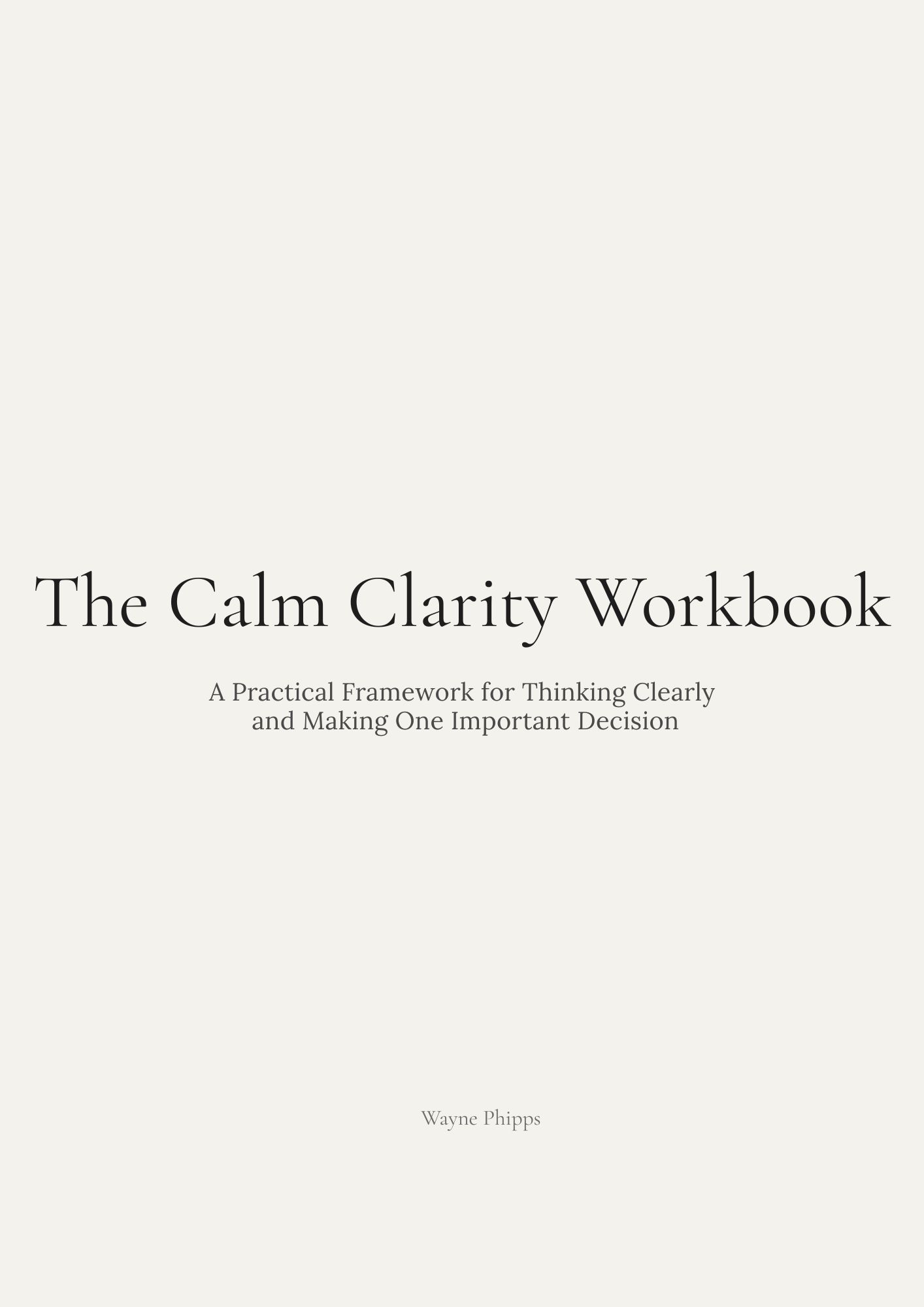
The Calm Clarity Workbook
f you’d prefer to work through a decision independently, the Calm Clarity Workbook provides a structured framework to move from tension to direction.
It’s practical, focused, and designed to help you define what you’re actually deciding — before you act.
No hype. No pressure. Just clear thinking.
The Over 50 Reset Brief
One considered email each week for people who want to think clearly about work, pressure and what comes next after 50.
Practical frameworks you can apply immediately
Lessons from my own decisions and experiments
Ideas that don’t always make it onto YouTube
No noise. Just one email a week.
If you value clear thinking over hype, this will suit you..
Thinking about your own situation?
If some of these ideas feel familiar but you are not yet sure what they mean for your own situation, the Next Stage gives you time, structure and practical support to work through the bigger picture gradually.
How people tend to use this space
Some people read a few ideas, watch a video, or take the Pressure Audit and leave with a bit more clarity than they had before.
Others come back over time, especially when similar questions keep resurfacing around work, health, money, pressure or what comes next.
Some eventually decide to apply for a Next Stage Consultation — not because they need someone to tell them what to do, but because it can help to slow things down and think through their own situation with more structure.
If nothing here feels urgent
That’s intentional.
This site isn’t designed to push you toward a decision or momentum.
It’s here so you can look at your own situation more clearly — and decide what, if anything, needs to change in your own time.
Wayne Phipps
Get the Over-50 Reset Brief
Writing and conversations about clarity, work, and enough
© 2026 Wayne Phipps. All rights reserved.
Wayne Phipps
Get the Over-50 Reset Brief
Writing and conversations about clarity, work, and enough
© 2026 Wayne Phipps. All rights reserved.
Wayne Phipps
Practical reflections on work, money and direction after 50.
The Over 50 Reset Brief-One email most weeks
© 2026 Wayne Phipps. All rights reserved.
Minimum Viable Income
Minimum Viable Income is a simple question: what is the smallest, honest amount of money that would allow you to live a life that feels workable and non‑anxious, for the season you’re in now?
Not a forever number. Not a social‑media number. Just a calm, present‑tense figure that covers your real costs and a bit of breathing room.
When you have this number, a few things often shift:
- Work ideas that sounded exciting but fragile can suddenly feel realistic.
- Projects that only make sense in a much wealthier future become easier to gently put down.
- You can see the difference between "I can’t afford this" and "I’m choosing not to prioritise this."
If you’d like to look at your own Minimum Viable Income, the Clarity session is one place to do that slowly and without performance pressure.
Noise vs Clarity
A lot of productive, kind people live with a constant background hum of "I should be doing more." This is noise, not guidance.
Clarity, in contrast, is usually quieter and less dramatic. It often sounds like: "This is enough for now." or "That would be nice, but it doesn’t need to happen this year."
One useful question is: if this thought became permanently true, would my life feel more spacious or more cramped?
In Clarity sessions we’re not trying to silence every anxious thought. We’re just trying to tell the difference between useful signals and old, automated noise so your choices can be a little kinder and more deliberate.
Time Drift
Time Drift is what happens when your calendar slowly fills with things you never consciously chose, until your days no longer look like the life you say you want.
No single meeting, obligation, or favour is the problem. It’s the slow tilt. A few degrees off, sustained over months and years.
A gentle way to notice drift is to compare two calendars:
- Your current, real week.
- A realistically good week, given your actual responsibilities, that would already feel like a relief.
In Clarity sessions we often map these two weeks side by side and look for the smallest, kindest adjustments that would start to close the gap without pretending your constraints don’t exist.